Decentralized Aerial Manipulation of a Cable-Suspended Load Using Multi-Agent Reinforcement Learning
Real-world experimental results
From left to right, top to bottom, the videos below show 1) Full-pose manipulation with 3 MAVs, 2) Robustness against complete in-flight failure of one MAV, 3) Full-pose manipulation with 4 MAVs, 4) Robstuness against unknown disturbances (15.4% of original load mass) placed in the load, which are free to move around, 5) Robustness against hetereogeneous agent setups, where one hacked MAV is commanded around with a different controller, and 6) Trajectory tracking of a figure-8. Note that our method is not trained for trajectory tracking. The entire pipeline is executed onboard, with the policies running at 100 Hz, and the low-level controller running at 300 Hz. Importantly, we achieve (near) constant computation time as we scale up the number of agents, and achieve similar tracking performance to a centralized NMPC benchmark.
Abstract
This paper presents the first decentralized method to enable real-world 6-DoF manipulation of a cable-suspended load using a team of Micro-Aerial Vehicles (MAVs). Our method leverages multi-agent reinforcement learning (MARL) to train an outer-loop control policy for each MAV. Unlike state-of-the-art controllers that utilize a centralized scheme, our policy does not require global states, inter-MAV communications, nor neighboring MAV information. Instead, agents communicate implicitly through load pose observations alone, which enables high scalability and flexibility. It also significantly reduces computing costs during inference time, enabling onboard deployment of the policy. In addition, we introduce a new action space design for the MAVs using linear acceleration and body rates. This choice, combined with a robust low-level controller, enables reliable sim-to-real transfer despite significant uncertainties caused by cable tension during dynamic 3D motion. We validate our method in various real-world experiments, including full-pose control under load model uncertainties, showing setpoint tracking performance comparable to the state-of-the-art centralized method. We also demonstrate cooperation amongst agents with heterogeneous control policies, and robustness to the complete in-flight loss of one MAV.Method overview
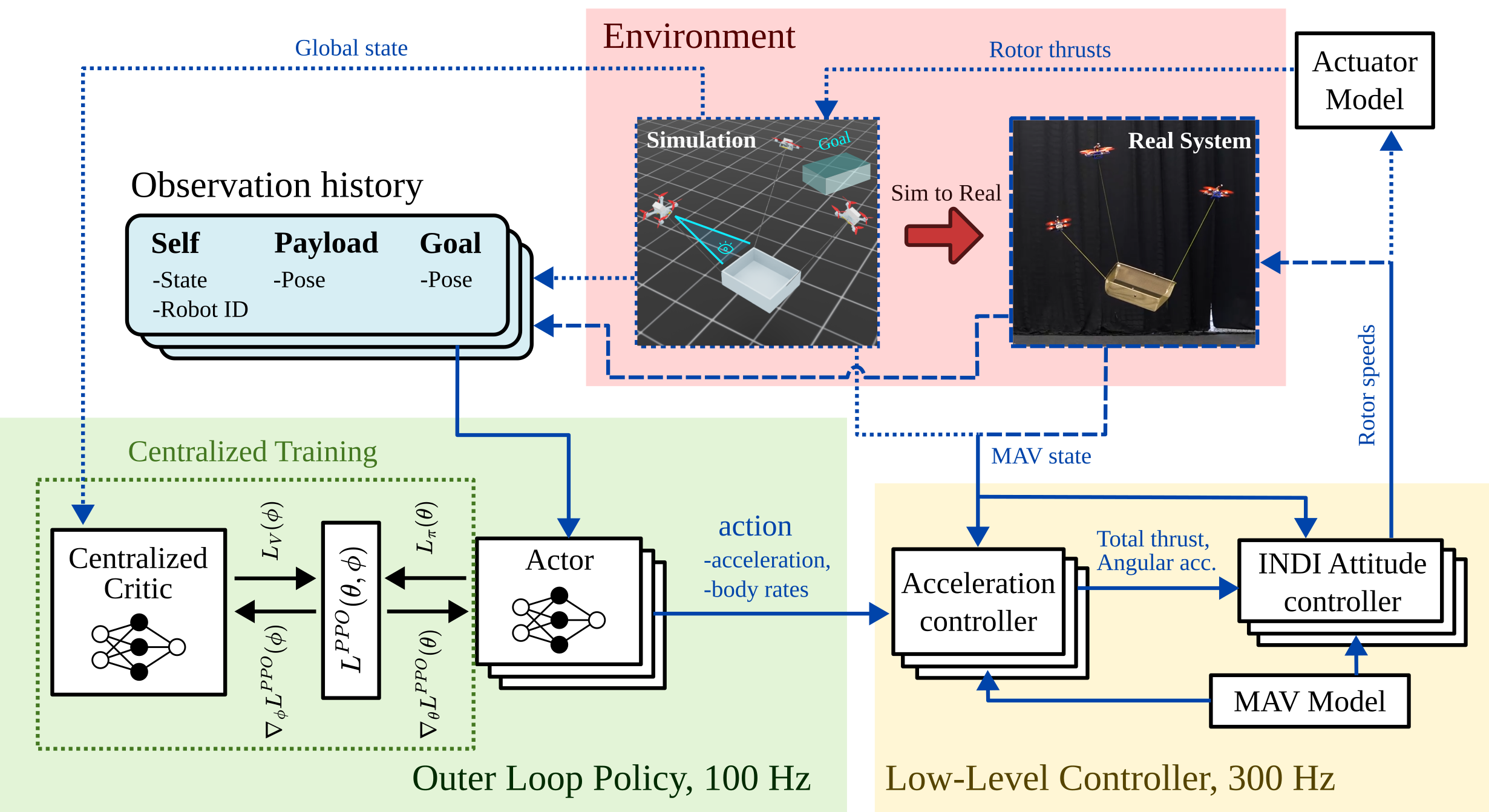
Overview of our method. Dotted lines indicate components only for training; dashed lines indicate those only for real-system deployment; solid lines for both. Our method utilizes MARL to train an outer-loop control policy, which generates reference accelerations and body rates for the low-level controller in real-time based on local observations of the ego-MAV state, its robot ID, payload- and goal pose. The low-level controller, including an INDI attitude controller, tracks these references based on the MAV model and accelerometer measurements. The privileged full state is observed by the centralized critic during training, which is discarded at execution time. Collected experience is shared across actors to update the parameters of a shared policy. This enables training to be centralized while execution remains decentralized, allowing each agent to run the policy independently onboard after zero-shot transfer from simulation to the real world.