HARPA: Heterogeneous Aerial Robot Teams for in-situ Prefabricated Building Assembly
About the Project
HARPA — Heterogeneous Aerial Robot Teams for in-situ Prefabricated Building Assembly started on 1 October 2026.
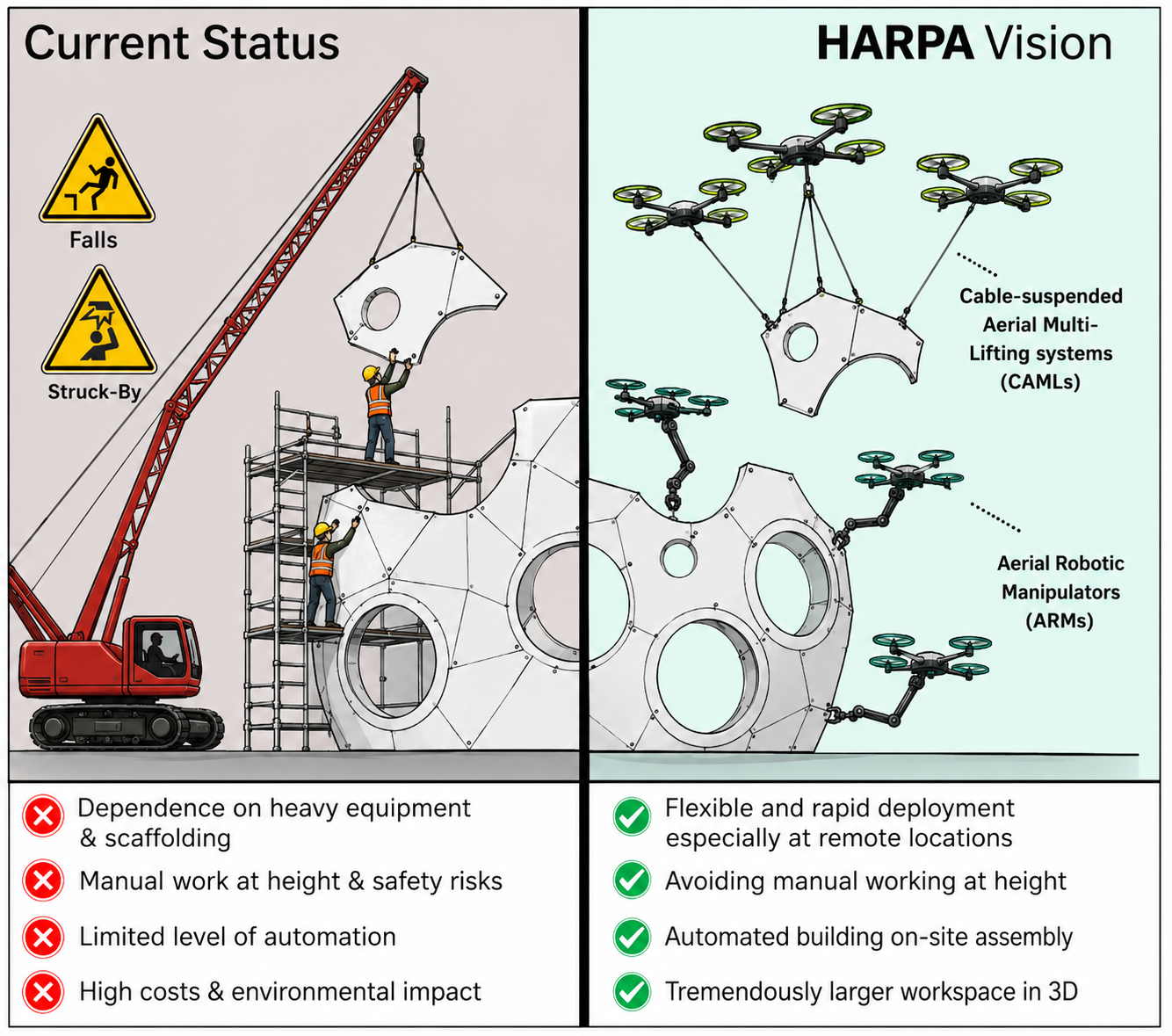
HARPA brings together aerial robotics and construction design to automate the assembly of prefabricated buildings. Cable-suspended Aerial Multi-Lifting systems (CAMLs) use several drones to carry and orient shared loads, while Aerial Robotic Manipulators (ARMs) align and connect the components. The goal is to reduce reliance on cranes, scaffolding, and manual work at height.
The project combines robot hardware, cooperative planning and control, perception, and digital-twin simulation with pavilion designs suited to aerial assembly. It aims to demonstrate autonomous assembly of a human-scale pavilion and explore cooperative lifting of construction loads above 200 kg.
Visit the HARPA project website for project news, research activities, and consortium information. The thumbnail is the construction vision illustration from HARPA's About page.
Funding & Partners
HARPA is funded by the European Union through the European Innovation Council (EIC) Pathfinder Challenge, under grant agreement ID 101306586.

The consortium consists of TU Delft (coordinator), Technical University of Munich (TUM), ETH Zurich, and FlyingBasket.