Multi Agent Motion Planning
About the Project
Multi-robot systems are designed to achieve tasks by collaboration. A key requirement for their efficient operation is good coordination and collision avoidance. Various methods have previously been proposed for single robot cases but when applied to multi-robot systems they often are computationally expensive. This project proposes novel collision avoidance strategies for a group of non-holonomic robots such as non-holonomic optimal reciprocal collision avoidance(NH-ORCA). A set of planners are developed for aerial vehicles as well that have low-computational complexity.
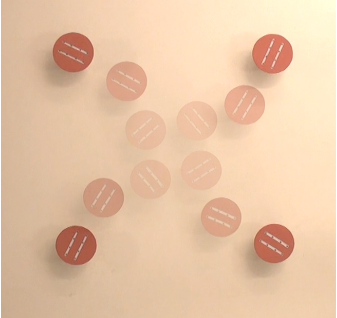
NH-ORCA works by controlling robots to stay within a maximum tracking error of the ideal trajectory. This builds on an approach called ORCA which worked well for holonomic robots. NH-ORCA is a fast and distributed method that can deal with crowded situations as well and helps robotic systems achieve smooth and visually appealing trajectories. Several experiments are conducted and recorded with a number of non-holonomic puck robots which help demonstrate the effectiveness of this method.
Another contribution of this project was the development of methods based on Velocity Obstacles(VO) to provide real-time motion planning for quadrotors. This provides a local motion planner which considers motion constraints, static obstacles and other agents. The approaches are either centralised or distributed and have been applied to varying sizes of quadrotor agent groups. Succesful performance was shown in these experiments with up to four quadrotors in close proximity and including humans.
Project Demonstrations
Funding & Partners
This project was performed at ETH Zurich and funded by Disney Research Zurich.
Related Publications
Cooperative Collision Avoidance for Nonholonomic Robots
J. Alonso-Mora, P. Beardsley, R. Siegwart.
In IEEE Transactions on Robotics, vol. 34, no. 2, pp. 404-420, 2018.
Collision Avoidance for Aerial Vehicles in Multi-Agent Scenarios
J. Alonso-Mora, T. Naegeli, R. Siegwart, P. Beardsley.
In Autonomous Robots, vol. 39, no. 1, pp. 101–121, 2015.
Collaborative Motion Planning for Multi-Agent Systems
J. Alonso-Mora, R. Siegwart, D. Rus.
In Workshop The future of multiple-robot research and its multiple identities at the IEEE/RSJ Int. Conf. on Intelligent Robots and Systems (IROS), 2014.
Towards Estimation and Correction of Wind Effects on a Quadrotor UAV
F. Schiano, J. Alonso-Mora, K. Rudin, P. Beardsley, R. Siegwart, B. Siciliano.
In Proc. of the Int. Micro Air Vehicle Conference and Competition, 2014.
Shared Control of Autonomous Vehicles based on Velocity Space Optimization
J. Alonso-Mora, P. Gohl, S. Watson, R. Siegwart, P. Beardsley.
In Proc. of the IEEE Int. Conf. on Robotics and Automation (ICRA), 2014.
A message-passing algorithm for multi-agent trajectory planning
J. Bento, N. Derbinsky, J. Alonso-Mora, J. Yedidia.
In Advances in Neural Information Processing Systems (NIPS), 2013.
Reciprocal Collision Avoidance with Motion Continuity Constraints
M. Rufli, J. Alonso-Mora, R. Siegwart.
In IEEE Transactions on Robotics, vol. 29, no. 4, pp. 899-912, 2013.
Collision Avoidance for Multiple Agents with Joint Utility Maximization
J. Alonso-Mora, M. Rufli, R. Siegwart, P. Beardsley.
In Proc. of the IEEE Int. Conf. on Robotics and Automation (ICRA), 2013.
Reciprocal Collision Avoidance for Multiple Car-like Robots
J. Alonso-Mora, A. Breitenmoser, P. Beardsley, R. Siegwart.
In Proc. of the IEEE Int. Conf. on Robotics and Automation (ICRA), 2012.
Limited benefit of Sharing Information in Multi-Agent Iterative Learning Control
A. Schoellig, J. Alonso-Mora, R. D'Andrea.
In Asian Journal of Control, vol. 14, no. 3, pp. 613-623, 2012.
Independent vs. Joint Estimation in Multi-Agent Iterative Learning Control
A. Schoellig, J. Alonso-Mora, R. D'Andrea.
In Proc. of the Conf. on Decision and Control (CDC), 2010.
Optimal Reciprocal Collision Avoidance for Multiple Non-Holonomic Robots
J. Alonso-Mora, A. Breitenmoser, M. Rufli, P. Beardsley, R. Siegwart.
In Proc. of the Int. Symp. on Distributed Autonomous Robotics Systems (DARS), 2010. Nominated Best Student Paper Award.