TamedPUMA: safe and stable imitation learning with geometric fabrics
1Mechanical Engineering, 2Electrical Engineering, Mathematics & Computer Science, TU Delft
By leveraging the recently introduced geometric framework for motion planning called geometric fabrics, our approach learns stable motion profiles while considering online whole-body collision-avoidance and joint limits.
Abstract
Using the language of dynamical systems, Imitation learning (IL) provides an intuitive and effective way of teaching stable task-space motions to robots with goal convergence. Yet, IL techniques are affected by serious limitations when it comes to ensuring safety and fulfillment of physical constraints. With this work, we solve this challenge via TamedPUMA, an IL algorithm augmented with a recent development in motion planning called geometric fabrics.
As both the IL policy and geometric fabrics describe motions as artificial second-order dynamical systems, we propose two variations where IL provide a navigation policy for geometric fabrics.
The result is a stable imitation learning strategy within which we can seamlessly blend geometrical constraints like collision avoidance and joint limits.
Beyond providing a theoretical analysis, we demonstrate TamedPUMA with simulated and real-world tasks, including a 7-DoF manipulator.
Keywords: Imitation Learning, Dynamical Systems, Geometric Motion Planning, Fabrics, Movement Primitives
Illustrative Point-mass Example
In Fig. 1 , trajectories are shown of a 2D point-mass example for the proposed methods, alongside baselines of geometric fabrics[1, 2] with a manually designed potential function, and PUMA[3]. The purely data-driven method PUMA follows the motion profile as learned from demonstrations, although it has no notion of obstacle avoidance or other physical constraints. The proposed methods, FPM and CPM, successfully follow the desired motion profile of PUMA, while avoiding collisions with the obstacles. In contrast, geometric fabrics are unable to follow the desired motion profile.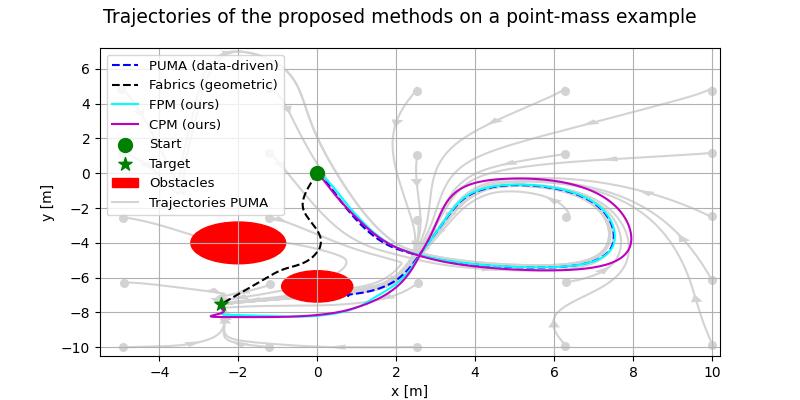
Experiment: Tomato picking with a 7-DoF manipulator
Demonstrating the tomato-picking task
Results of the tomato-picking task with TamedPUMA
Via TamedPUMA, PUMA is enhanced for safe and stable navigation, while accounting for whole-body collision avoidance and joint limits. We propose two variations, the Forcing Policy Method (FPM) and the Compatible Potential Method (CPM). Note that the robot-hand is controlled via a binary open-close when the target pose is reached within the tolerance.FPM
In the FPM, convergence to the goal is not guaranteed, but works well in practice.
CPM
CPM provides a stronger notion of goal convergence than the FPM. In practice, the performance is similar to FPM.
An out-of-distribution scenario
When an obstacle forces the robot towards a pose far from the demonstrations, TamedPUMA recovers and reaches the goal.
Human disturbances
When a human disturbs the robot, TamedPUMA can recover and converges to the goal.
Experiment: Pouring a liquid
Avoiding the helmet
TamedPUMA avoids collisions with the helmet while performing a learned pouring task.
Online goal changes
Using TamedPUMA, the goal can be changed online.
Comparison with geometric fabrics and PUMA
Note: The following videos might not display in Chrome, but they do render in Firefox, we are addressing this problem!Geometric Fabrics
Fabrics causes a deadlock scenario with two obstacles representing the side of the box.
TamedPUMA (ours)
The DNN encodes an intuitive movement to avoid the side of the box.
PUMA
Via PUMA, the demonstrated movement is learned while ensuring goal converge. Obstacle avoidance and physical constraints are NOT considered.
TamedPUMA (ours)
Via TamedPUMA, PUMA is enhanced for safe and stable navigation. Whole-body collision avoidance and joint limits are incorporated.
Appendix - Supplementary material on TamedPUMA
This PDF contains additional theoretical analysis on the proofs, differential mappings and pseudo-code for TamedPUMA.This link guides to the webpage with theoretical details on TamedPUMA, as also explored in Section 1 of the pdf.
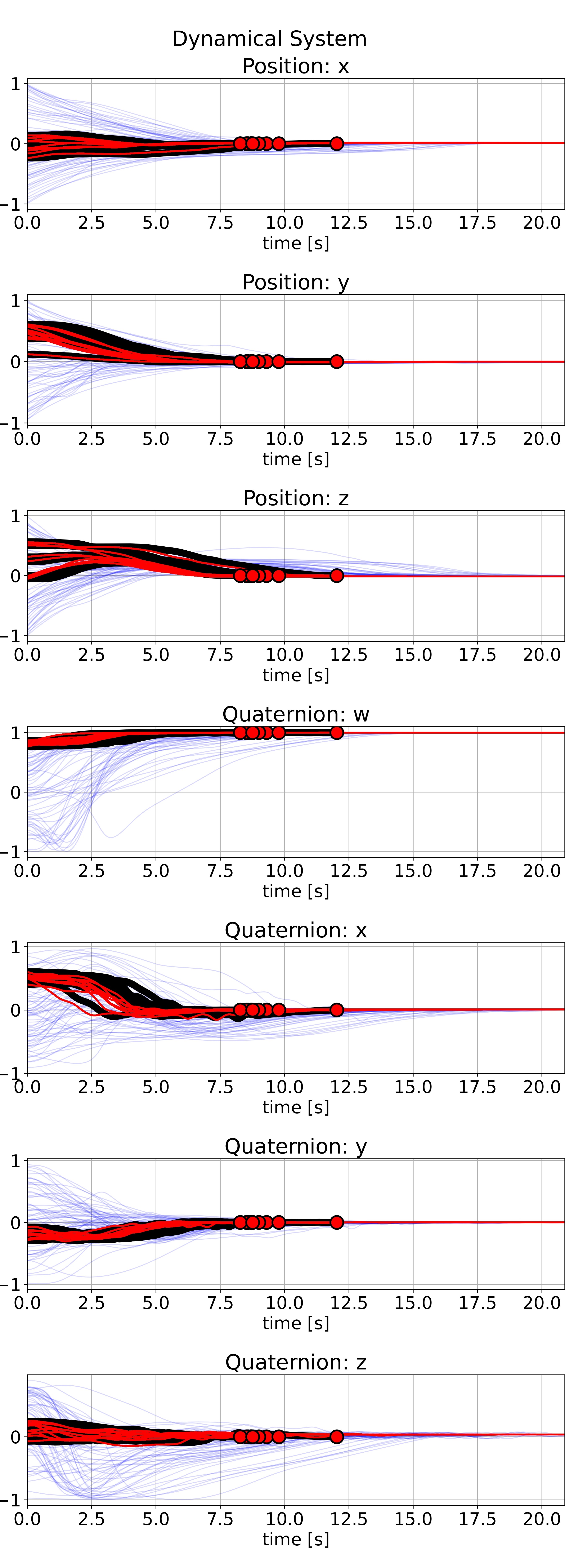
Learned dynamical systems are often trained in a normalized position and orientation space. To obtain the correct inputs for the network from joint positions and velocities, we require forward kinematics and transformations with respect to Euclidian and non-Euclidian spaces. The output of the network is mapped to a joint acceleration via a pullback operation, as in Eq. (6) in the paper.
Section 2 in the PDF explores the required differential mappings of PUMA to map these inputs and outputs of the DNN.
Pseudo-code of the algorithm can also be found in the Section 3 of the document.
Limitations
One limitation of TamedPUMA is that its optimization is conducted separately from fabrics. Consequently, because physical constraints are overlooked during training, it is still possible to obtain infeasible trajectories in the real system, especially when starting from states far from the support of the demonstration data. In such cases, PUMA might find solutions that lead to TamedPUMA reaching zero velocity, due to the fabrics component, in states other than the goal state $\vec{x}_{\textrm{g}}$. Furthermore, this approach alters the behavior of the learned system when PUMA is integrated with fabrics, which, in some cases, may cause undesired deviations in the system's behavior.The DNN provides a trajectory leading to an undesirable configuration, as PUMA is unaware of the physical limitations.
Human errors ...
Specifications of the DNN by PUMA
| Hyperparameter | Value (tomato-picking) | Value (pouring) | |
|---|---|---|---|
| PUMA | Stability loss margin ($m$) | 1e-6 | 1e-6 |
| Triplet imitation loss weight ($\lambda$) | 1.0 | 1.0 | |
| Window size imitation ($\mathcal{H}^i$) | 13 | 13 | |
| Window size stability ($\mathcal{H}^s$) | 2 | 2 | |
| Batch size imitation ($\mathcal{B}^i$) | 800 | 800 | |
| Batch size stability ($\mathcal{B}^s$) | 800 | 800 | |
| Neural Network | Optimizer | Adam | Adam |
| Number of iterations | 40000 | 27000 | |
| Learning rate | 1e-4 | 1e-4 | |
| Activation function | GELU | GELU | |
| Num. layers ($\varphi_{\theta}, \rho_\theta$) | (3, 3) | (3, 3) | |
| Layer normalization | yes | yes |
Specifications of the joint impedance controller
| Parameters | Value | |
|---|---|---|
| Joint impedance controller | Stiffness position | [600, 600, 500, 450, 180, 100, 40] |
| Damping position | [61, 61, 33, 32, 20, 12, 7] | |
| Stiffness velocity | [950, 950, 850, 680, 290, 170, 85] | |
| Damping velocity | [61, 61, 33, 32, 18, 11, 7] |
References
- Ratliff, Nathan, and Van Wyk, Karl. (2023). "Fabrics: A Foundationally Stable Medium for Encoding Prior Experience." arXiv preprint arXiv:2309.07368.
- Ratliff, Nathan D., Van Wyk, Karl, Xie, Mandy, Li, Anqi, and Rana, Muhammad Asif. (2020). "Optimization fabrics." arXiv preprint arXiv:2008.02399.
- Pérez-Dattari, Rodrigo, Della Santina, Cosimo and Kober, Jens. (2024). "Deep metric imitation learning for stable motion primitives." Advanced Intelligent Systems.
Related Publications
Pushing Through Clutter With Movability Awareness of Blocking Obstacles
In IEEE Int. Conf. on Robotics and Automation (ICRA), 2025.
Globally-Guided Geometric Fabrics for Reactive Mobile Manipulation in Dynamic Environments
In IEEE Robotics and Automation Letters (RA-L), 2025.
Safe and stable motion primitives via imitation learning and geometric fabrics
In Robotics: Science and Systems, Workshop on Structural Priors as Inductive Biases for Learning Robot Dynamics, 2024.
Reactive grasp and motion planning for adaptive mobile manipulation among obstacles
In Robotics: Science and Systems, Workshop on Frontiers of Optimization for Robotics, 2024.
Multi-Robot Local Motion Planning Using Dynamic Optimization Fabrics
In Proc. IEEE International Symposium on Multi-Robot and Multi-Agent Systems, 2023.